 Sports Business Brand Latest Brand News, Sports, Entertainment, Marketing, Sponsorships

By Ojeikere Aikhoje

The 2026 FIFA World Cup, scheduled from June 11 through July 19, will redefine the scale and scope of global sport.
For the first time in tournament history, 48 national teams will compete across three host nations — the United States, Canada, and Mexico — spanning four time zones and creating the most geographically expansive World Cup ever staged.
More than just a football tournament, the 2026 edition represents a landmark moment in sports geography, logistics, tourism, cultural and international business.
A Continental Tournament
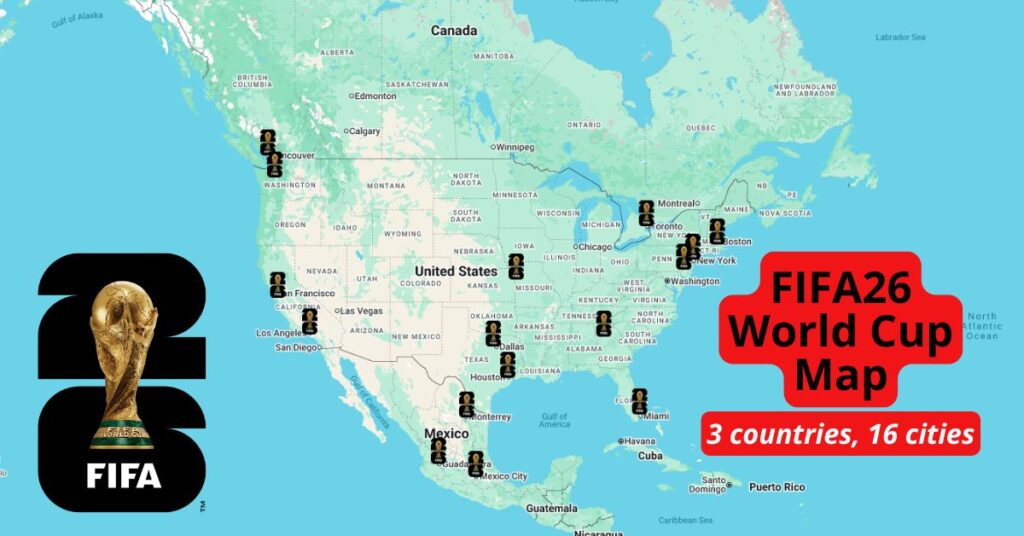
The tournament will be shared among North America’s three largest nations, with 16 host cities spread across thousands of miles.
Canada
Toronto, Vancouver
Mexico
Mexico City, Guadalajara, Monterrey
United States
Seattle, San Francisco, Los Angeles, Dallas, Houston, Kansas City, Atlanta, Miami, Philadelphia, Boston, New York/New Jersey.
The United States will host the majority of the tournament’s 104 matches, while Canada and Mexico will stage key fixtures that showcase the continent’s cultural and geographic diversity.
Geography Creates New Business Challenges
The unprecedented geographic scale of the 2026 World Cup introduces major logistical and operational challenges for teams, sponsors, broadcasters, and supporters.
Travel distances between venues will be unlike anything seen in previous tournaments, forcing teams to reconsider traditional preparation models. Rather than operating from a single training base, many federations are expected to adopt flexible “venue-hopping” strategies to reduce travel fatigue and maximize recovery time.
For fans and corporate partners, transportation planning, accommodation demand, and cross-border mobility will become central components of the World Cup experience.
Airlines, hospitality companies, and tourism agencies are expected to benefit from a massive increase in continental travel throughout the tournament.
Climate Diversity Across North America
One of the defining features of the 2026 World Cup will be the dramatic variation in climate and playing conditions across host cities.
Matches could take place in:
- the intense heat and humidity of Miami, Houston, and Monterrey,
- the cooler Pacific Northwest conditions of Seattle and Vancouver,
- or the high-altitude environment of Mexico City.
These environmental contrasts will influence player performance, recovery, training schedules, and even tactical preparation, adding another layer of complexity for teams competing across multiple regions.
Historical Geography and Legacy
Mexico City’s iconic Estadio Azteca will become the first stadium in history to host matches in three FIFA World Cups, following its appearances in 1970 and 1986.
The venue remains one of the sport’s most symbolic landmarks and reinforces Mexico’s historic connection to global football culture.
Economic and Cultural Geography
Beyond sport, the 2026 FIFA World Cup is expected to generate billions in economic activity through tourism, transportation, hospitality, infrastructure, media rights, and sponsorship.
The expanded 48-team format also broadens the tournament’s cultural reach, bringing new nations such as Cape Verde, Curaçao, Jordan, and Uzbekistan, fan communities, and commercial markets into the global football ecosystem.
Host cities across North America are preparing for an unprecedented fusion of cultures, with downtown districts expected to transform into international gathering spaces filled with supporters from every continent.
In many ways, the 2026 World Cup will not simply be a football tournament, it will be a large-scale demonstration of how geography, business, culture, and global sport intersect in the modern era.
About the writer