 Sports Business Brand Latest Brand News, Sports, Entertainment, Marketing, Sponsorships

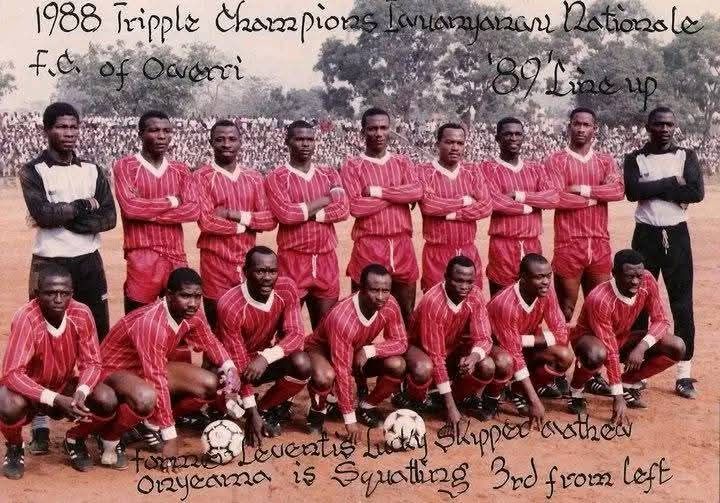
Iwuanyanwu Nationale won the Old Division in 1988 and 1989. The team claimed the first Professional League title in 1990 to complete a hattrick.
By Kunle Solaja.
Thirty-six years after professional football was introduced in Nigeria, the country’s top-flight league continues to grapple with many of the same structural problems critics warned about decades before the professional era began.
The Nigerian Professional Football League officially commenced on May 12, 1990, following nearly 40 years of debate over whether the country was prepared for the financial realities of professional sports.
When professionalism was first proposed in the 1950s, opponents questioned whether Nigerian clubs could survive the burden of player salaries, stadium maintenance and administrative costs.
Former football administrator Derby Allen warned in 1953 that most clubs lacked suitable stadiums and sustainable revenue streams to operate professionally.
More than seven decades later, many NPFL clubs are still heavily dependent on state government funding, while issues such as poor infrastructure, irregular player welfare, low commercial returns and weak marketing continue to limit the league’s growth.
Despite these challenges, the league has survived political transitions, administrative crises and financial instability to become one of Africa’s longest-running domestic competitions.
The league’s history has featured remarkable moments and strange twists.
Kwara United F.C. endured a 14-match losing streak in 2000, while Udoji United F.C. controversially emerged champions in 1996 following boardroom decisions.
Traditional giants have also suffered dramatic declines. Bendel Insurance F.C., one of the pioneer clubs of the 1972 National League, were relegated for the first time in 1995 and later spent a decade outside the top division after another relegation in 2008.
Defending champions Shooting Stars SC suffered relegation in 1999, becoming the first title holders to fall out of the top flight, while Bayelsa United F.C. repeated the unwanted feat in 2010 and has now suffered another drop.
Even continental giants, Enyimba F.C., once experienced relegation in 1991. Another relegation looms large at the end of this season.
Only Enugu Rangers have maintained an unbroken stay in the top division since the National League era began in 1972.
Administrative instability has equally shaped the NPFL’s story.
From NFA Control to Independent Board
In 2005, the league left direct NFA control with the establishment of the Nigeria Premier League.
The League Management Company later emerged after a court ruling declared the NPL illegal in 2012/13.
Today, the Nigeria Premier Football League board oversees the competition, which continues to seek improved television coverage, sponsorship and stronger club structures.
As the league celebrates its 36th anniversary, many observers believe its future success will depend on finally resolving the same financial and organisational issues identified long before professionalism arrived in 1990.